Warehouse robots are taking on more work because many warehouse tasks repeat at fixed locations, while orders and staffing can change from day to day. The useful question is not whether a robot looks advanced. It is whether the system moves goods safely, fits the building, and earns back its cost.
Quick read
- Repeated travel is a good fit for mobile robots.
- Software links robots to orders, shelves, scanners, and people.
- A robot still needs clear rules, service, charging, and human oversight.
Where robots help first
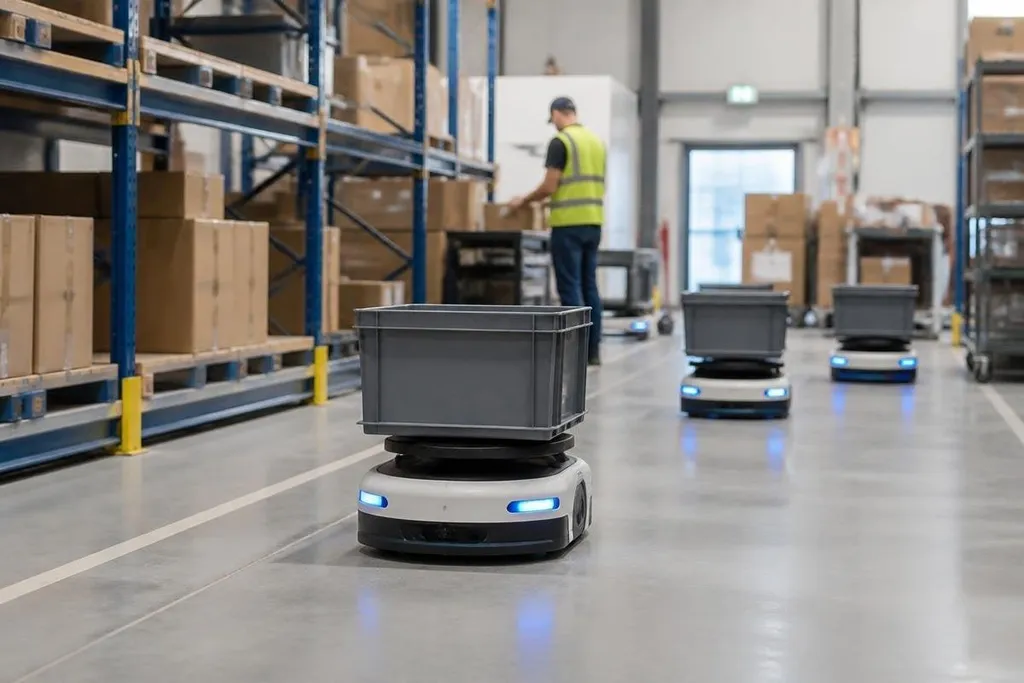
The easiest tasks to automate involve clear routes and steady steps. An autonomous mobile robot, or AMR, can carry a tote between storage, picking, packing, and shipping areas. Sensors help it detect people and objects, while software selects a safe route around the building.
That changes the work around the robot. A picker may spend less time walking to collect a tote and more time handling items at a station. The gain comes from removing travel from the task, not from making each hand movement faster.
Robotic arms fit a different part of the process. They can pick known items, place cartons, sort packages, or load a conveyor when the objects arrive in a repeatable position. Cameras and force sensors help the arm deal with changes in shape, location, and weight, but messy piles remain difficult.
The distinction matters for a warehouse manager. A robot that carries a standard tote through a marked route has a clearer job than an arm expected to pick every item from an unarranged bin.
Why the software matters
A warehouse robot rarely works alone. It needs order data from a warehouse management system, location data from maps or markers, and rules that define where people and machines may move. A barcode scanner can confirm the item, while the fleet software can assign the next task.
That link between physical work and software is where many projects succeed or fail. If the inventory record is wrong, the robot can reach the correct shelf and still bring back the wrong product. If a charging area blocks a fire exit or a busy aisle, the robot adds a new problem to the building.
A warehouse robot can reach a shelf in seconds and still fail at the handoff when the receiving station rejects its tote. Robot 24 reports can put that failure beside the software rules and site layout behind the run. The next section looks at limits a smooth test may hide.
The limits are easy to miss
Warehouse robots need space, power, maintenance, and clear operating rules. A mobile robot may stop when a pallet blocks its route. An arm may fail when packaging changes or an item has a reflective surface. These events can reduce output even when the robot works as its maker intended.
People also remain part of the system. They handle unusual items, clear blocked routes, inspect equipment, and respond when a safety sensor stops motion. Training must cover these jobs before the robot enters daily work.
The financial case needs the same care. The purchase price is only one part of the cost. Installation, software fees, site changes, spare parts, battery replacement, service time, and worker training belong in the same calculation.
I'd skip a robot project that starts with a machine and searches for a task afterward. Start with the repeated movement, measure its cost, then test the smallest system that can do that work safely.
A buying checklist
Before choosing a warehouse robot, check these points:
- Name the task: Record the item, weight, route, handoff, and exception that the robot must handle.
- Measure the baseline: Count trips, touches, waiting time, and staff hours during a normal shift.
- Check the building: Map aisle width, floor changes, lighting, doors, lifts, charging space, and emergency routes.
- Test the software link: Confirm how orders, inventory records, scans, alarms, and manual overrides will work together.
- Plan service: Set response times for faults and keep the parts, tools, and training needed for repairs.
- Set a pass mark: Agree on safe output, uptime, recovery time, and the cost limit before the trial starts.
A small trial can answer questions that a product video cannot. Run the robot on real items, during busy periods, with the same packaging and staff who will use it. Record every stop and manual intervention, then compare the results with the baseline.
These systems are becoming more important because they can take on repeated movement while people handle exceptions and decisions.
The next useful step is a measured trial with a defined task, a known cost, and a clear answer about what happens when the robot stops.